
Blog
Modalert Side Effects: What to Know About Safety & Risks


UK Clinical & Regulatory Disclaimer
This article about Modalert side effects is provided for general educational and informational purposes only. It is not medical advice and should not replace consultation with a qualified healthcare professional. Modalert contains modafinil, a Prescription-Only Medicine (POM) in the UK. The safety information discussed is primarily based on established modafinil evidence and may not represent Modalert-specific clinical findings. Individual reactions can vary. Anyone experiencing suspected serious adverse reactions should seek prompt medical attention.
Modalert side effects are an important consideration when assessing the safety of medicines containing modafinil. Modalert is a branded modafinil product, and its active ingredient is a wakefulness-promoting medicine used to treat certain sleep-related conditions. Like other prescription medicines, modafinil can cause unwanted effects, ranging from headache and nausea to less common but potentially serious reactions.
Understanding Modalert side effects requires a clear distinction between clinical evidence for modafinil and evidence for Modalert specifically. Most established safety information comes from clinical trials, regulatory assessments and official product documents for modafinil rather than independent clinical studies of Modalert.
In the UK, modafinil is a Prescription-Only Medicine (POM). Its authorised use focuses on excessive sleepiness associated with narcolepsy in adults.
This article examines common and serious adverse reactions, factors that may influence medicine safety and relevant UK regulatory guidance. It also explains the limitations of applying general modafinil findings to an individual branded product.
What Are the Possible Modalert Side Effects?
Modalert contains modafinil, an active pharmaceutical ingredient that affects pathways involved in wakefulness. Although researchers understand several aspects of its pharmacological activity, its precise mechanism of action remains incompletely understood.
The possible Modalert side effects are therefore commonly assessed using the established safety profile of modafinil.
However, clinical findings from other modafinil formulations do not automatically constitute independent evidence for Modalert.
UK-authorised modafinil medicines have official Summary of Product Characteristics (SmPC) documents. These describe adverse reactions identified through clinical trials and safety reports collected after medicines entered clinical use.
Such documents provide an important basis for understanding ingredient-related risks. Nevertheless, they cannot independently confirm the frequency or severity of adverse reactions for every internationally marketed brand.
Product formulation also matters. Medicines containing the same active ingredient may differ in their inactive ingredients, manufacturing processes and regulatory documentation.
The article on Modalert 200 mg ingredients and product information examines the brand’s pharmaceutical identity and formulation in greater detail.
A future comprehensive Modalert guide will address the product’s broader characteristics separately.
Headache and Digestive Symptoms
Headache is the most frequently reported adverse reaction in the cited UK modafinil product information.
The SmPC reports headache in approximately 21% of patients within the clinical evidence it describes.
Importantly, this percentage relates to the studies supporting that product’s safety documentation. It should not be presented as a Modalert-specific headache rate.
Digestive complaints are another relevant part of the general modafinil safety profile.
Reported symptoms include:
- Nausea and abdominal discomfort.
- Dry mouth.
- Diarrhoea or constipation.
- Indigestion, also known as dyspepsia.
- Reduced appetite.
The severity and duration of these effects can vary between individuals.
Furthermore, clinical trial results reflect particular study populations and conditions. They cannot predict how a specific person will respond to a medicine.
Modalert Side Effects Involving Sleep and Nervousness
Insomnia is a recognised adverse reaction associated with modafinil.
Because the medicine promotes wakefulness, changes in normal sleeping patterns form an important part of its safety profile.
Some individuals report difficulty falling asleep or maintaining their usual sleep routine.
In addition, modafinil safety documentation identifies several psychological and nervous-system effects, including:
- Nervousness and anxiety.
- Irritability.
- Agitation or restlessness.
- Dizziness.
- Blurred vision.
Dizziness and visual disturbances may also affect activities requiring coordination and attention, including driving.
However, these effects do not necessarily occur together. Their severity and frequency cannot be determined from the Modalert brand name alone.
The adverse-reaction classifications in UK product information relate to the medicine and evidence described in those documents rather than independently verified Modalert-specific findings.
Serious Modalert Side Effects: What Does the Evidence Show?
Serious Modalert side effects must also be considered in the context of established modafinil safety warnings.
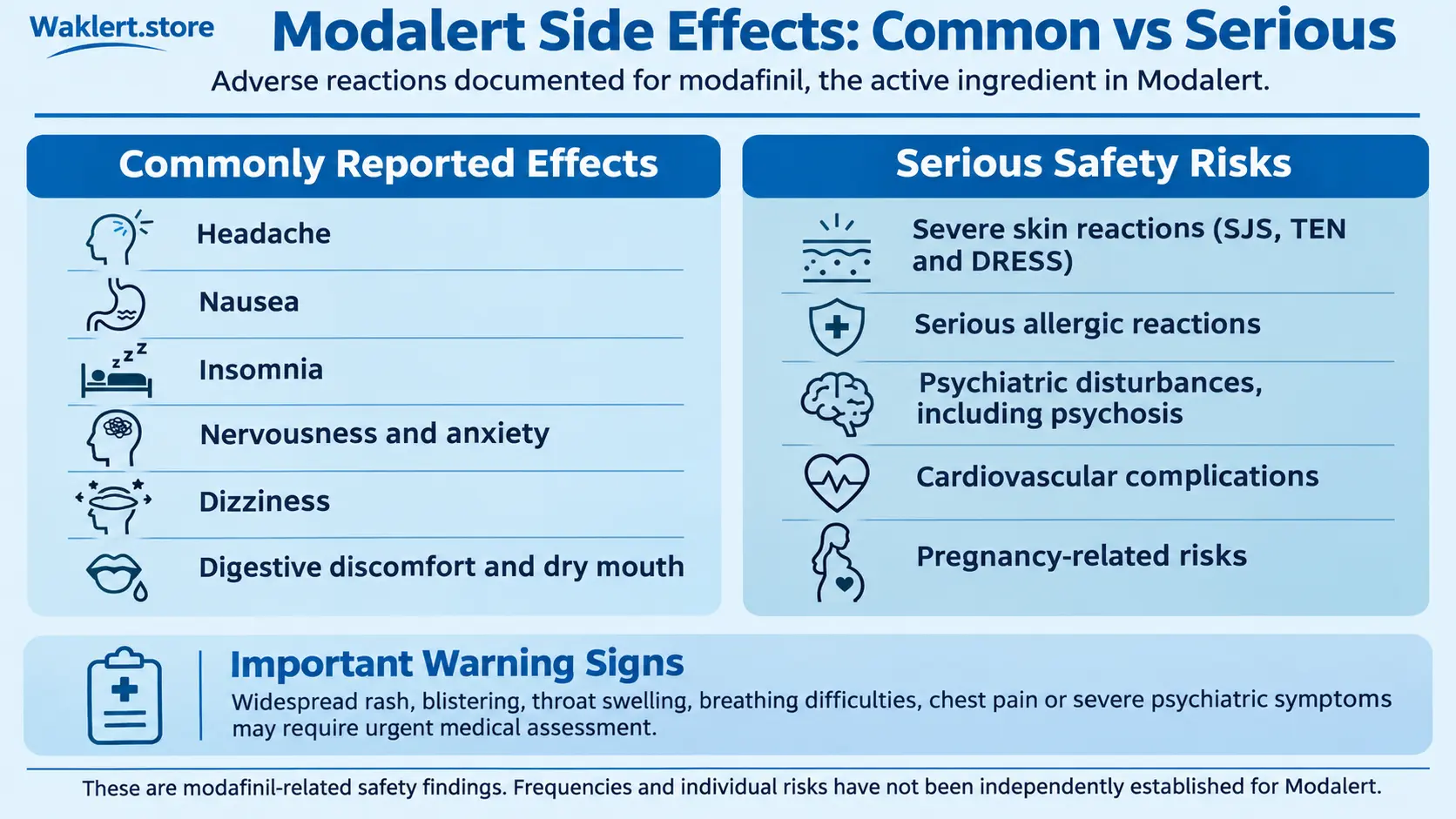
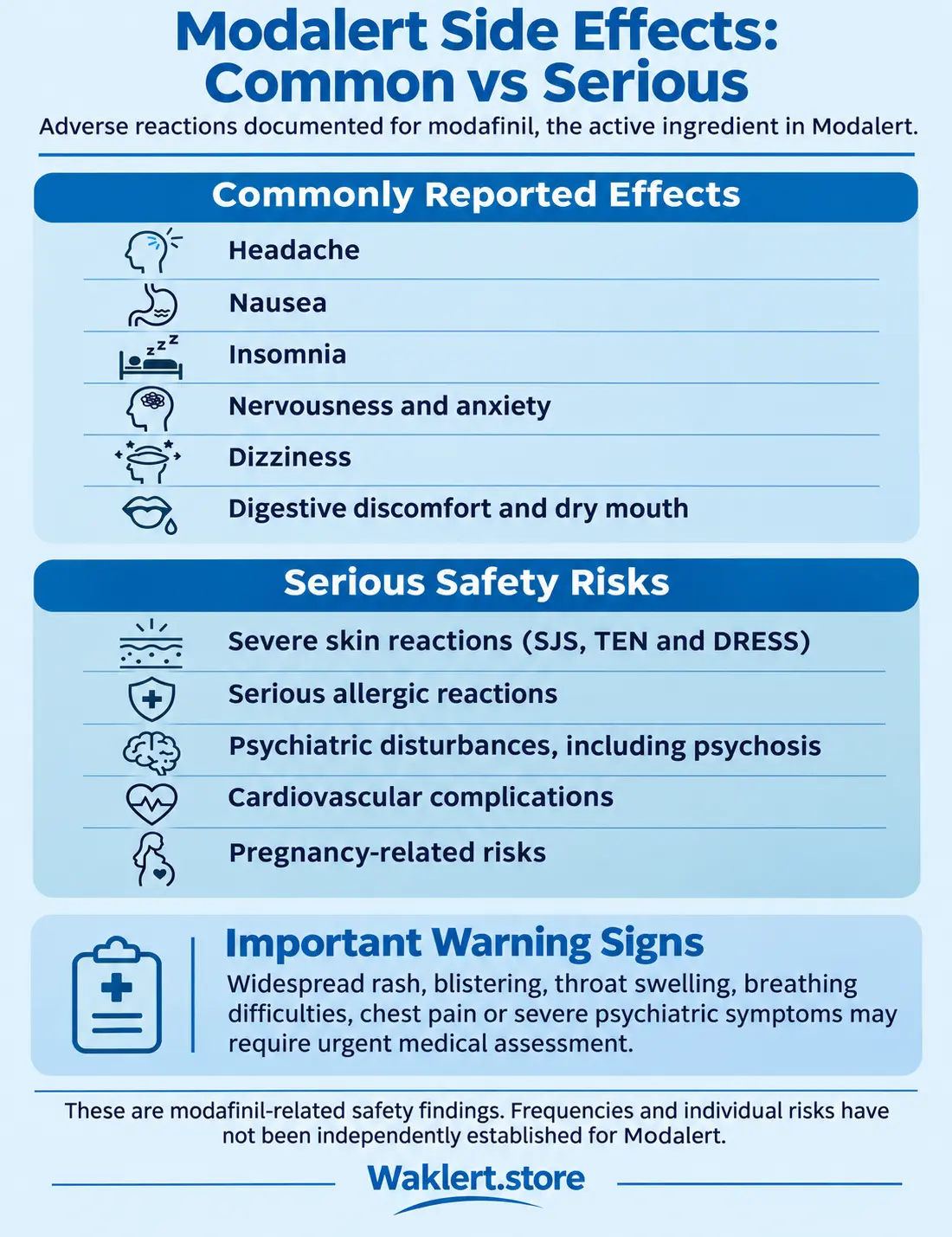
Although common adverse reactions often involve headache, digestive discomfort or sleep disturbance, modafinil has additional warnings concerning severe skin reactions, hypersensitivity, psychiatric symptoms and cardiovascular complications.
These risks appear in official UK medicine information and the MHRA safety guidance on modafinil’s restricted use and associated risks.
Some reactions may require urgent medical assessment, even though they are not typical experiences for most patients.
Serious Skin Reactions and Hypersensitivity
Modafinil has been associated with rare but potentially life-threatening skin reactions.
Reports include:
- Stevens–Johnson syndrome (SJS): A severe reaction that can affect the skin and mucous membranes.
- Toxic epidermal necrolysis (TEN): A serious condition involving extensive skin damage and detachment.
- Drug reaction with eosinophilia and systemic symptoms (DRESS): A severe medicine reaction that can involve the skin, blood and internal organs.
Possible warning signs include widespread rash, blistering, peeling skin, fever and sores affecting the mouth or other mucous membranes.
Modafinil has also been associated with serious allergic reactions and multi-organ hypersensitivity.
These reactions may involve facial or throat swelling, breathing difficulties, fever or signs of organ involvement.
The UK SmPC instructs that modafinil should be discontinued at the first sign of a rash and not restarted. Suspected severe skin reactions, breathing difficulties or throat swelling require urgent medical attention.
Importantly, reports collected after a medicine reaches the market do not always allow researchers to establish a reliable frequency for uncommon serious reactions.
Therefore, the available evidence does not justify assigning a specific Modalert adverse-reaction rate to these conditions.
Psychiatric and Cardiovascular Warnings
Psychiatric and cardiovascular concerns are important when examining the potential Modalert side effects linked to modafinil.
UK product information identifies possible changes in mental health, including the appearance or worsening of anxiety, depression, irritability and agitation.
More serious reported psychiatric reactions include hallucinations, manic symptoms, psychosis and suicidal thoughts or behaviour.
These warnings do not mean that every person taking modafinil will experience psychiatric difficulties.
However, existing psychiatric conditions may influence clinical risk assessment. This includes a history of depression, bipolar disorder or other significant mental health conditions.
Cardiovascular safety is another important consideration.
Reported adverse effects include palpitations, increased heart rate and changes in blood pressure. Official product information also identifies abnormal heart rhythms among relevant cardiovascular concerns.
The MHRA highlights cardiovascular assessment and monitoring within prescribed treatment, particularly when patients have underlying heart conditions or blood-pressure problems.
Severe psychiatric symptoms, chest pain or significant changes in heart rhythm warrant prompt professional assessment.
Overall, these warnings reflect established modafinil safety evidence, not independent clinical trials demonstrating the precise risks of Modalert.
What Factors Can Influence Modalert Side Effects?
Several factors may influence how individuals experience adverse reactions to modafinil.
Official medicine information identifies existing health conditions, other medicines and differences in drug metabolism as relevant considerations.
For example, a person’s psychiatric history may affect the assessment of anxiety, mood changes or other psychological symptoms.
Similarly, cardiovascular conditions can influence the clinical significance of palpitations, changes in heart rate or blood-pressure effects.
Medicine interactions also require attention.
Modafinil affects certain liver enzymes involved in processing medicines. As a result, it can change exposure to some other treatments.
One particularly important interaction involves hormonal contraception. UK regulatory guidance warns that modafinil can reduce the effectiveness of certain hormonal contraceptives.
In addition, individual differences in how the body processes modafinil may affect drug exposure and tolerability.
Nevertheless, current clinical evidence does not provide a reliable method for predicting every adverse reaction an individual might experience.
Understanding these factors helps place Modalert side effects within the wider context of medicine safety. However, they form part of professional medicine assessment rather than a basis for calculating personal risk from general product information.
Modalert Side Effects and Sleep Quality
Sleep disturbance deserves particular attention when examining Modalert side effects because modafinil promotes wakefulness.
Insomnia appears in official modafinil adverse-reaction documentation. Consequently, changes in sleeping patterns are relevant to the medicine’s overall safety profile.
However, reported insomnia does not necessarily establish a measurable change in every aspect of sleep quality.
Researchers distinguish between symptoms such as difficulty falling asleep and outcomes measured through formal sleep studies.
For example, sleep architecture describes the organisation of different sleep stages. Sleep efficiency measures the proportion of time in bed that a person spends asleep.
Reports of insomnia alone cannot establish how modafinil affects these outcomes.
Furthermore, underlying sleep disorders, existing sleep disruption and other individual factors may contribute to sleep-related symptoms.
The relationship between Modalert and sleep therefore requires careful interpretation.
This article focuses on insomnia as a recognised adverse reaction rather than drawing broader conclusions about long-term sleep quality or changes in sleep architecture.
UK Regulatory Guidance on Modalert Side Effects and Safety
UK regulation provides an important framework for understanding medicine safety and interpreting reports of Modalert side effects.
In the United Kingdom, modafinil is classified as a Prescription-Only Medicine.
Its authorised indication concerns excessive sleepiness associated with narcolepsy in adults, with or without cataplexy.
Following a European review of its benefits and risks, regulatory authorities restricted modafinil’s licensed use.
Earlier indications involving shift-work sleep disorder and obstructive sleep apnoea did not remain within the restricted authorised indication.
This change reflected concerns about the balance between potential benefits and recognised risks across different clinical populations.
The MHRA also maintains systems for monitoring suspected adverse reactions after medicines enter clinical use.
Members of the public and healthcare professionals can report suspected medicine-related adverse reactions through the official MHRA Yellow Card Scheme.
These reports help regulators identify and investigate emerging medicine safety concerns. However, a report of a suspected reaction does not, by itself, establish that a particular medicine caused it.
Pregnancy and Contraception Warnings
Pregnancy-related risks form a significant part of UK modafinil safety guidance.
In November 2020, the MHRA published updated information highlighting a potential increased risk of congenital malformations following modafinil exposure during pregnancy.
Reported concerns included congenital heart defects, hypospadias and orofacial clefts.
The MHRA guidance on modafinil, pregnancy risks and contraception states that modafinil should not be used during pregnancy.
It also specifies the requirement for effective contraception during treatment and for two months after stopping modafinil.
This warning is particularly important because modafinil may reduce the effectiveness of steroidal contraceptives, including certain oral hormonal contraceptives.
The MHRA’s guidance therefore addresses both pregnancy exposure and potential interactions with contraception.
These warnings concern the active ingredient modafinil and are not unique to Modalert.
Modalert and UK Marketing Authorisation
The regulatory status of an active ingredient must be distinguished from the authorisation of an individual branded medicine.
Modafinil appears in UK-authorised prescription medicines. However, this does not automatically establish that every internationally marketed brand containing modafinil has UK marketing authorisation.
Accordingly, Modalert should not be described as a UK-authorised branded medicine without confirmation through an appropriate product-specific regulatory record.
UK-authorised medicines have official product documentation, including Summaries of Product Characteristics and patient information leaflets.
These documents explain authorised indications, contraindications, adverse reactions and other regulatory information for the specific medicine.
By contrast, evidence relating to a different formulation cannot confirm Modalert’s individual authorisation status.
This distinction matters when interpreting both medicine safety information and claims about regulatory approval.
Comparing Modalert Side Effects With Other Modafinil Brands
Different branded medicines can contain the same active ingredient without having identical formulations.
For example, manufacturers may use different inactive ingredients, production methods and product documentation.
Therefore, shared modafinil content provides a basis for discussing ingredient-related adverse reactions, but it does not establish that every product has the same brand-specific safety evidence.
The article on Modvigil 200 mg side effects discusses safety considerations for another branded modafinil product.
Both discussions require the same distinction between established modafinil evidence and findings independently verified for a particular brand.
Neither the Modalert nor Modvigil brand name establishes a superior safety profile.
Similarly, a clinical trial involving a UK-authorised generic modafinil formulation should not be presented as independent evidence of adverse-reaction frequencies for either brand.
Consequently, comparisons involving Modalert side effects should distinguish documented ingredient-level risks from product-specific information requiring separate verification.
Understanding Modalert Side Effects: Key Takeaways
The following table summarises the main safety findings and the limits of the available evidence.
Safety topic | Established evidence | Important distinction or limitation |
Headache and nausea | Documented adverse reactions to modafinil | Published frequencies are not necessarily Modalert-specific |
Insomnia and nervousness | Recognised reactions in modafinil safety documentation | Individual sleep-related effects vary |
Serious skin reactions | Serious post-marketing cases have been reported | A reliable Modalert-specific frequency is unavailable |
Psychiatric risks | Recognised warnings include psychosis and suicidal thoughts | Individual clinical circumstances influence risk |
Cardiovascular effects | Palpitations, heart-rate changes and blood-pressure concerns are documented | Underlying cardiovascular health is relevant |
Pregnancy | MHRA warns of a potential increased risk of congenital malformations | The warning concerns modafinil regardless of brand |
UK regulatory status | Modafinil is prescription-only | Active-ingredient authorisation does not prove Modalert brand authorisation |
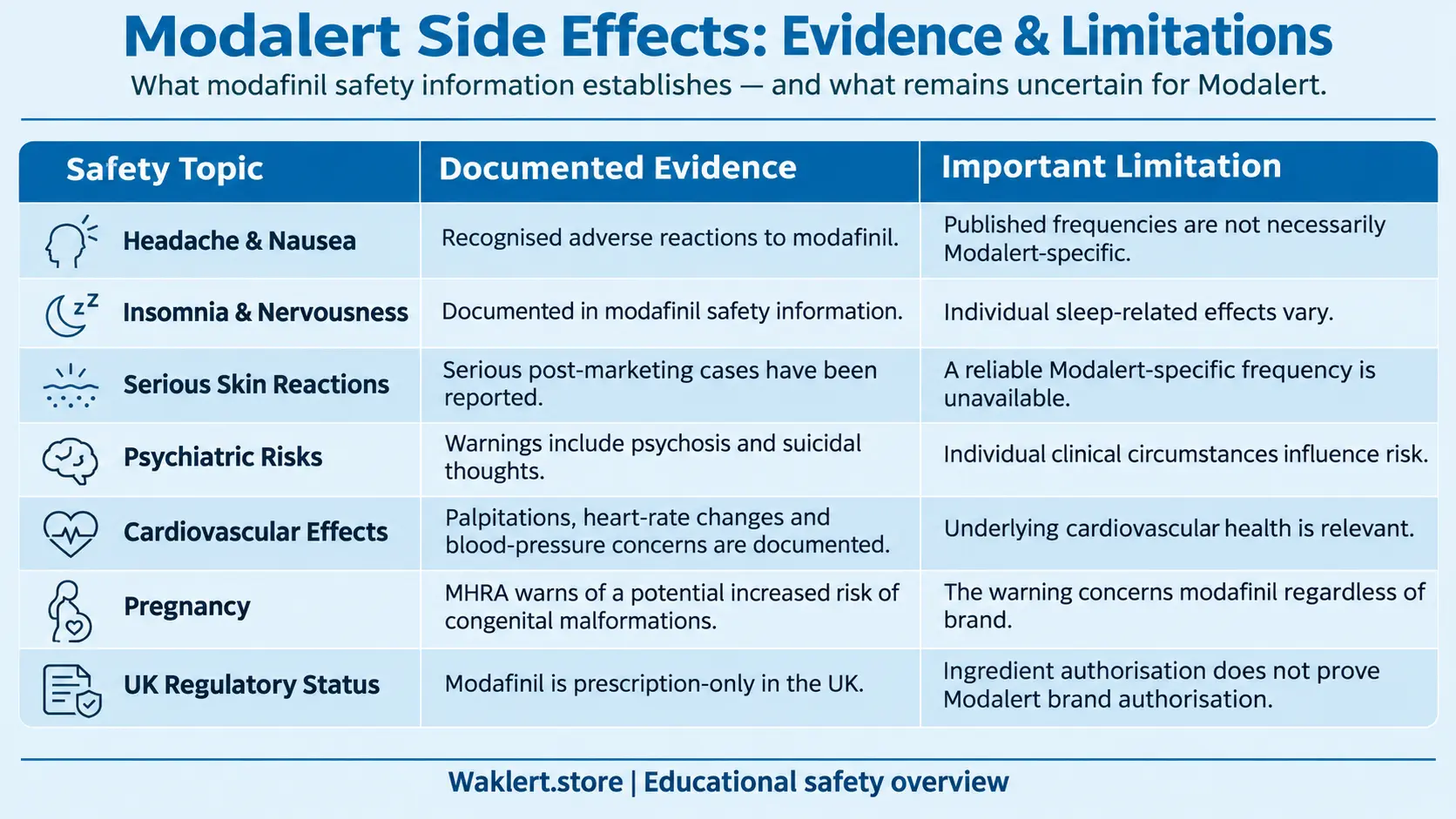
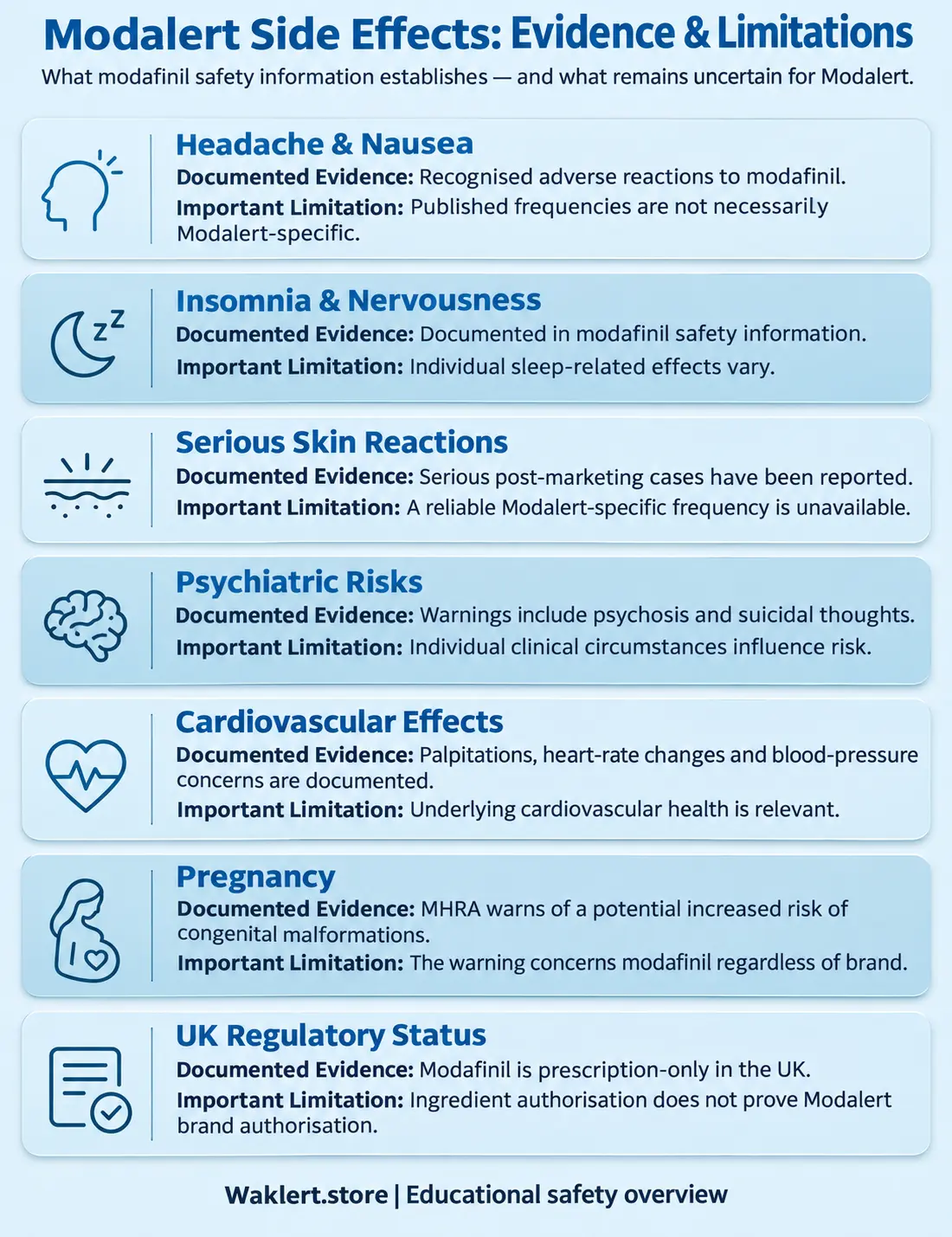
These findings provide a framework for interpreting medicine safety information without assuming that all brands have identical clinical evidence.
Frequently Asked Questions About Modalert Side Effects
What Are the Most Common Modalert Side Effects?
The most commonly discussed Modalert side effects come from established modafinil safety evidence. Headache, nausea, insomnia, nervousness and dizziness are among the recognised adverse reactions. Other reported effects include digestive discomfort, dry mouth and anxiety. However, UK product information does not independently establish how frequently these reactions occur with Modalert specifically.
Can Modalert Cause Serious Adverse Reactions?
Because Modalert contains modafinil, its safety considerations include serious reactions associated with that active ingredient. These include severe skin reactions, hypersensitivity, psychiatric disturbances and cardiovascular complications. Such reactions differ from more commonly reported symptoms. Their frequency cannot be established from the brand name alone. Suspected serious reactions may require urgent medical assessment.
Can Modalert Side Effects Affect Normal Sleep Patterns?
Insomnia is a recognised adverse reaction associated with modafinil, the active ingredient in Modalert. Its wakefulness-promoting effects may contribute to difficulties with normal sleep routines. However, reports of insomnia do not establish every aspect of sleep quality. Conclusions about sleep architecture, sleep efficiency or longer-term sleep outcomes require research using appropriate measurements.
Are Modalert Side Effects the Same as Those of Other Modafinil Medicines?
Modalert shares the active ingredient modafinil with other branded and generic medicines. Therefore, general modafinil safety warnings remain relevant. However, products may differ in formulation, inactive ingredients, manufacturing documentation and regulatory status. Clinical findings from a UK-authorised modafinil medicine should not be described as independent Modalert-specific safety data without supporting evidence.
Final Summary of Modalert Side Effects and Safety Risks
Understanding Modalert side effects requires a clear distinction between established modafinil safety evidence and findings verified for the individual branded product.
Headache, nausea, insomnia, nervousness and dizziness are among the recognised adverse reactions associated with modafinil. More serious concerns include severe skin reactions, psychiatric disturbances, cardiovascular complications and pregnancy-related risks.
UK regulatory guidance provides an important foundation for interpreting these findings, particularly because modafinil is a Prescription-Only Medicine with a restricted authorised indication.
Ultimately, a reliable assessment of Modalert safety depends on accurate ingredient-level evidence, appropriate regulatory documentation and recognition of the limits of available brand-specific research.

About Waklert Store Research Desk
Waklert Store Research Desk is the internal editorial team behind Waklert Store's educational content on Modafinil and Armodafinil. All articles are prepared using publicly available medical references, UK regulatory guidance, and internal editorial review standards.View all posts by Waklert Store Research Desk
View all posts by Waklert Store Research Desk